
Quick story to lead off. I was helping a Fortune 50 company with their AEO strategy, and they did not want to hear about FAQ schema being unsupported. They didn't care that Perplexity serves different citation patterns than ChatGPT. Markdown files? Pssh.
What they wanted was global insight to inform where they want to invest in the next 3 years. Highly matrixed, multi-region, multi-products. They wanted to know where their consumers were actually searching, and nobody could tell them cause attribution has been failing for some time now.
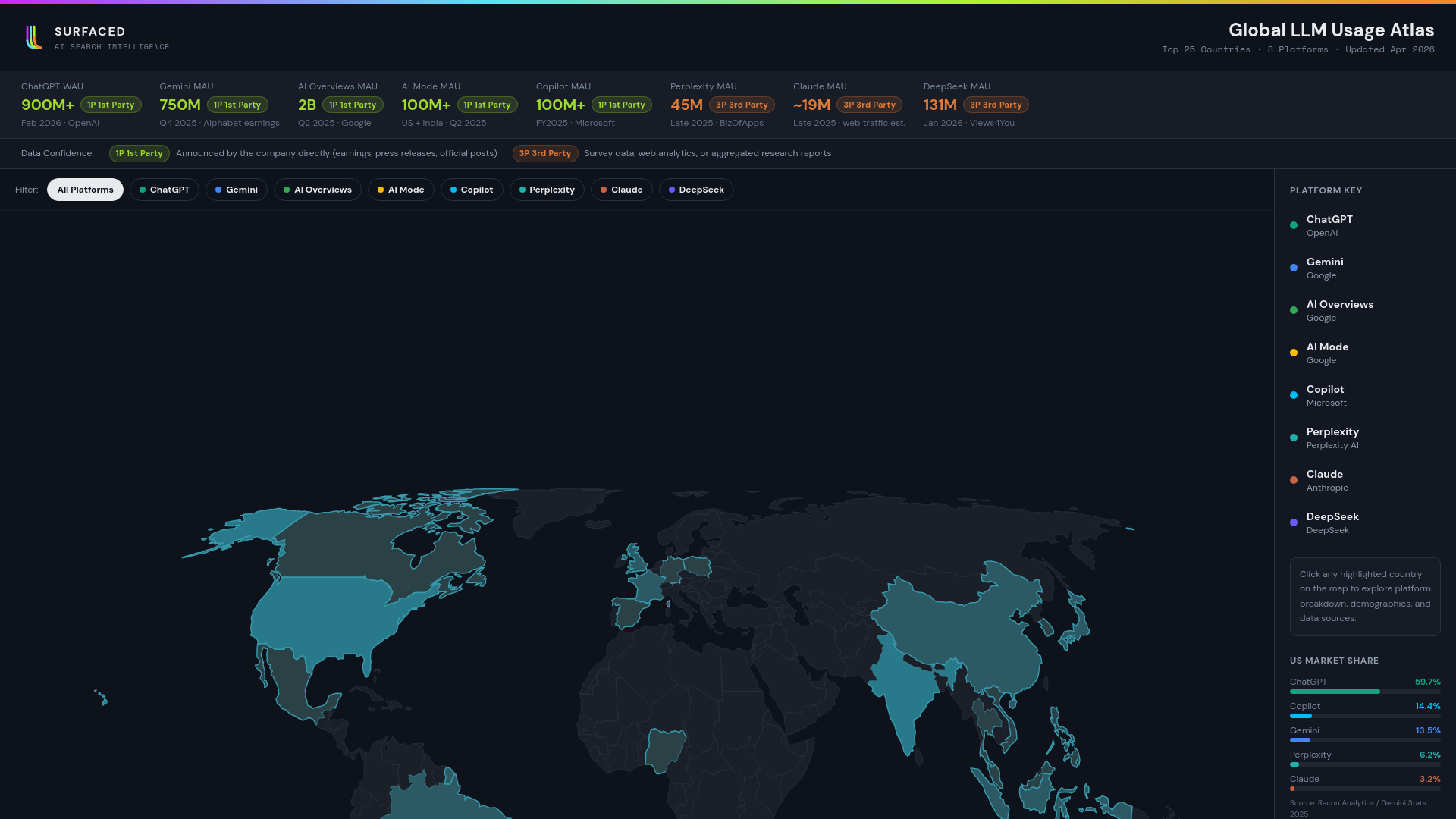
So I went and looked, and it was a hot mess. China runs its own entire ecosystem, with Southeast Asia being extremely fragmented. ChatGPT and Perplexity adoption is scattered across regions with wildly different penetration, while Google is basically everywhere. The MAU numbers came from earnings calls, sampled web traffic aggregators, and analyst reports that disagreed with each other. Globally, it was stitching together
Then there's the demographic layer, because a number is useless without knowing who is behind it. Men or Women? Young or Old? New users or existing?
Every source needed to be weighted by credibility, so I built an agent with a skill to do that weighting and paint the picture.
What came out was an interactive HTML asset. Shareable, screenshotable, distributed internally to regional teams so they could navigate their own challenges. Not a deck that dies in somebody's downloads folder. A living resource that gets refreshed quarterly as new usage data lands.
The deliverable wasn't research. It was something the org could use on their own, without me in the room.
Because you’re part of the newsletter, here’s the link to the mock-up artifact for you to check out as a proof-of-concept I provided them.
Hope this is inspirational, or at least shares how to go about solving problems bigger than technical minutiae.
Onward!

Lots of news happening in the publishing world which will change both strategy and measurement for the long term. The sum is that citation patterns will continue to shift over the foreseeable future as sources get juggled around. I yapped about this a bit on LinkedIn.
1) ChatGPT's and Google’s honeymoon might be over.
ChatGPT integrated Yelp on July 23. This is them “diversifying their portfolio”. Reviews, ratings, and photos pulled in directly, with Yelp's brand riding along.
ChatGPT getting Yelp in its corner as Google is leaning on its own business directory is a David vs. Goliath story if you ask me.
Yelp previously licensed content to Google before that relationship deteriorated, and Yelp is now suing Google over favoring its own local results. A messy love triangle.
2) Reddit and Google honeymoon is also potentially over.
Reddit and Google’s deal on leveraging trained content is coming to an end Q1 2027. Will they renew their vows?
Both the company’s stocked tumbled because of this news, as it definitely deteriorates the trust built between the two companies.
My take is they will go their separate ways; Google wants to be self-sustaining in its own ecosystem, and got what they needed out of trained data from the past. If Google can’t find other ways, they might not have the leverage to walk away, though.
3) Google giving publishers opt-out
Google began testing a control in June 2026 (UK) that lets publishers keep content out of AI Overviews, AI Mode, and Discover generative features while staying in traditional results, and it's now rolling out to others.
The catch is that opting out means losing AI click data entirely. Webmasters doing this are playing with fire potentially, but this was in response to being sued…so….yeah.
4) Cloudflare is now fighting against all LLMs
Starting September 15, 2026, all new signups and free-tier Cloudflare (they run a lot of the internet) customers get default bot management settings that block multi-purpose crawlers.
They have even announced a “Monetization Gateway” earlier in July, literally a digital toll booth to charge for access to web pages, datasets, APIs, or MCP tools.
They noted that this is part of the same movement about the shift to pay content creators and not have their work be hijacked.
Cloudflare is the hero we all needed, apparently.
This is absolutely just going to slowly (and quietly) shift the way the internet functions. The sum of these parts is to expect a lot of disruption from citation patterns and sourced domains.

LinkedIn spent the week on one finding. SimilarWeb's new Generative AI Landscape Report (43% of searchers are AI Overviews, up 15% YoY), amplified by Aleyda Solis, found a real disconnect between the pages ChatGPT cites and the pages that actually receive referral traffic. Citation and traffic have come apart, and the internet has been going bananas over the idea that citations do not mean much; it’s about how you’re mentioned.
A citation is evidence you entered the consideration set - it is not a promise of a visit. If your AI dashboard is treating citation count as a traffic proxy, you're measuring the wrong end of the funnel.
Another thread I liked was organizational. Kaleigh Moore's piece on the Head of AEO role nobody owns yet is circulating, and the numbers behind it are pretty telling: 28% of new AI search role postings are leadership positions, and 61% of companies still haven't assigned ownership. Saw this when I was at Brandlight, can confirm. More on that in office hours below.
Over on Reddit, a popular myth died this week.
DEJAN agency (Dan Petrovic is super smart) published citation data showing Reddit gets rejected by OpenAI 99.39% of the time, and pulls zero citations from Anthropic. Meanwhile, Perplexity leans on Reddit heavily, roughly 47% of its sources in one analysis. Remember the market share of these two are nothing compared to Google, though.
So "be everywhere on Reddit for AI visibility" turns out to be platform-agnostic advice.
I'm watching small teams freeze up because they can't do everything at once. You don't have to. Pick the surface your audience actually uses and commit to it - with Google being the top choice in almost every scenario.

The most important thing published this month is academic, and almost nobody in marketing has read it because it’s heavy.
On July 15, a survey of 45 GEO studies, published between November 2023 and July 2026, landed on arxiv. Huge compilation that was probably curated using AI ;)
The finding? No evaluated technique consistently improves organic discoverability, downstream traffic, or business outcomes across AI platforms.
That widely quoted 40% visibility increase from AEO/GEO rewrites? It comes from a single metric measuring how prominent your content is after it has already been retrieved. Not whether it gets retrieved at all…so it’s biasing your data already.
The summary of the survey of 45 studies finds GEO rewrites can cut a page's AI retrieval by 16%!
Andrew, what’s the tldr? We’re still really early on practically everything related to measuring AI, and it’s probabilistic outcomes, and my take is that you should be doing incremental testing to see what works for YOU, and not follow internet playbooks.
They might have bad prompts, measurement, and methodology. Do it yourself.

Audit your entity, not just your site.
Google is citing its own Business Profile cards and Knowledge Panels as the second most common source in AI Mode. That means your entity data is competing with your website to be the answer, and most teams have never assigned it an owner because why would you?
Truth is, your entity is much harder to influence, partly because it’s not something that you can just crawl your website for and optimize, and it lives in a collection of third-party sources.
What that looks like this week:
Pull up your Google Business Profile and your Knowledge Panel and look at them the way a stranger would. Is the description current? Are the categories right? Is the product data accurate?
Search your brand name and read the entity card Google returns. If it describes the company you were three years ago, that's what AI Mode is working from, so fix that shit.
Find the gaps between your entity and your actual positioning. Schema isn't for rich results anymore; it's for building your knowledge graph and finding where AI's understanding of your brand is wrong.
Assign an owner. Not a project, an owner. This is the step that never happens cause projects get deprioritized; add it to someone’s goals.
Low effort, weeks rather than months, and it sits in the gap between web, brand, and local (if that matters to you).

"We're standing up AI search as a real program. Where should it live, and do we need to hire a Head of AEO?"
A version of this has come up twice in the last few weeks, and the LinkedIn conversation about the Head of AEO role from Kaleigh is making it louder.
My answer is usually unsatisfying: don't start with the title.
A new role is another node in your stack.
A stack is a list of technologies and people you've assembled into an OS.
An operating system is how those technologies, resources, and teams actually talk to each other. It defines how content gets ideated, how it gets optimized, and how it gets distributed internally to the functions that need it, like CS, social, and content marketing.
Hiring a Head of AEO into an org without that operating system just gives the confusion a reporting line. AEO? Isn’t that SEO? Are the two redundant? Who is going to make it out alive?
Three questions I'd ask before anyone writes a JD:
How many other teams does your search group talk to in a given quarter? If the answer is one or two, they aren't leveraging the organization, and a title won't change that.
What responsibilities does AEO have vs SEO? If it’s not clearly articulated, I’d fear redundancy. Have clear differences in the role, as some SEO’s will adopt, and some organizations might want to accelerate their programs.
If I asked three people on your team what your AI search strategy is, would I get the same answer?
This one is why most teams overestimate their maturity by roughly a tier and a half (if you want to know your maturity tier, let’s talk).
Ask a search director about their strategy, and they'll explain it fluently.
Ask the stakeholders how that work actually gets produced, and it’s crickets.
I watched this play out at a top-10 global financial services firm. Heavily regulated, multiple regions, a tangled technology stack that made moving anything across the finish line genuinely hard. They rolled out AI right as search was getting infused with it, and there was no mandate from leadership other than telling people to “test it out”.
The technology sat there for six months. The teams that did pick it up went in different directions, each solving for their own wins instead of a shared business case. What they got out of it was versioning problems and output nobody else could use because they were all using it selfishly for themselves.
So before the hire, RASCI the thing. Who owns what, who drives each deliverable, who just needs to be informed. Then check the three legs: a dedicated team, technology that enables them, and a clear line up to executive leadership, all underwritten by a strategy that matches the resources you actually have.
If one of the legs is short, the whole thing will break. Do that, and the ownership question tends to answer itself.
Sometimes the answer really is a new hire. Sometimes not.
Organizational change is where my focus has been lately, even though data and tactics are what flood the airwaves. I’m working on finding ways to incorporate more of it into this newsletter.

If you're staring at a budget or an org chart trying to work out where this stuff goes, reply and tell me where you're stuck. Happy to think it through with you.
Appreciate you all. Enjoy your August.
Until next time,
Andrew